
"art"

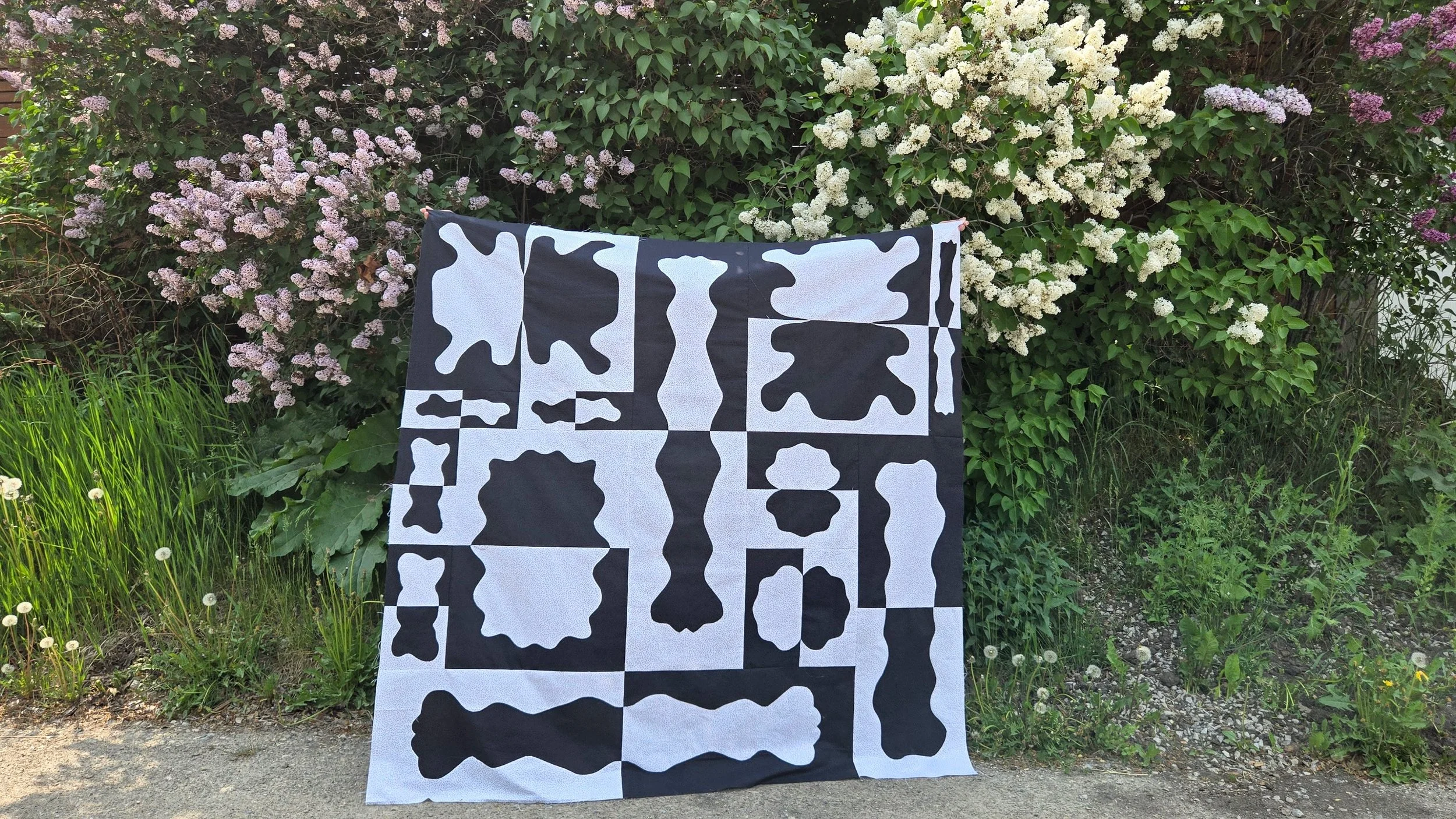
A Notan Inspired Quilt Top

Have you heard of Notan? I know it as a Japanese paper cutting art form where the positive and negative space, or the light and dark aspects mirror each other. There are more in depth or different interpretations but they all come down to the interplay between the light and dark. I love it all.

In the early spring I’d finished two scrap quilts full of riotous colour. I decided I NEEDED to try out an idea that popped in my head. Just a couple of blocks, no expectations. Some hand applique, creative cutting, and only black and white fabric. I was thinking about Notan and how the concepts could be applied to fabric. So I grabbed two rectangles of fabric, one black and one white, and I cut them. And immediately I knew my idea did not work. At least not without some additional layers for success.

In the Notan of my inspiration you take one piece of paper, the black, let’s say. And you cut it. You then get the design of the black ON the white, with the white showcasing the design. On one side it will look like a white design with a black background and the other side will look like a black design on a white background, but the designs are the same/mirrored. And you only cut one of the papers, the light or the dark. This concept is absolutely doable in fabric too - with one cut only - provided you either have raw edges or do not factor in seam allowances.

In my interpretation I cut through the black and white fabrics at the same time. This is because if I only did one cut and then tried to mirror the pieces with applique the seam allowances would change things enough that it wouldn’t look like a mirror. In more detail, let’s say I cut a triangle from a rectangle of black. I appliqué the triangle itself on another white rectangle. The triangle gets smaller because I’ve turned under the edges for the needle turn applique. But I want a mirror piece so I then take the remaining square of black that has the triangle cut out of it and applique it on another square of white (one with the same outside dimensions as the square of black). Now the opening of the cut triangle becomes bigger because, again, seam allowances. So the two white triangles do not end up the same size. In the end, then, I would cut through a black and white fabric at the same time, plus cut additional background fabrics (two white and two black) so that I ended up with four blocks, or two mirrored sets. The way that I solved the problem of the different seam allowances was that I mirrored the blocks that had the center portions of the cut blocks in one set and mirrored the background appliqués in the other set.
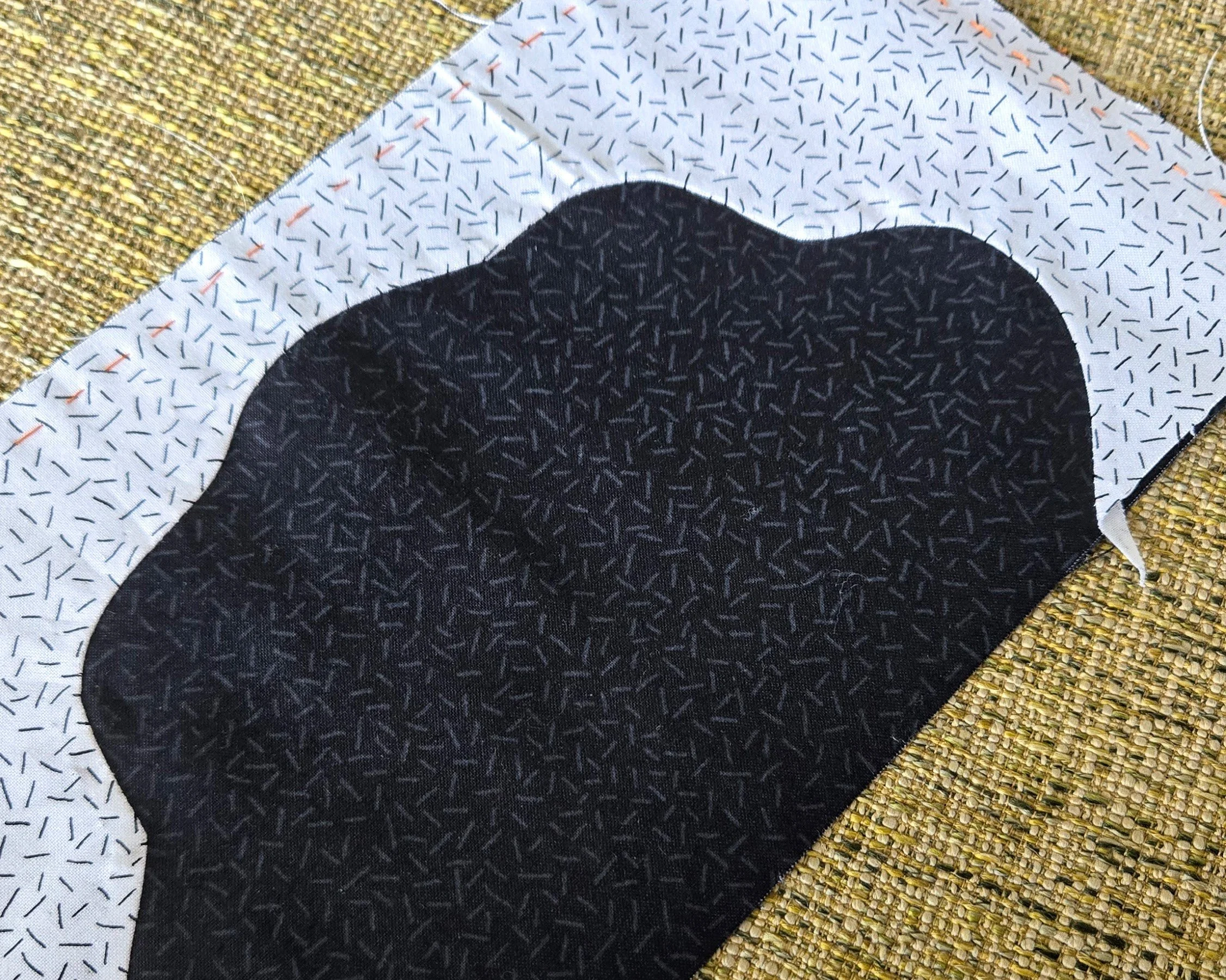
This is the background cut piece (the white) appliquéd on to a piece of black. Think of it like reverse applique.
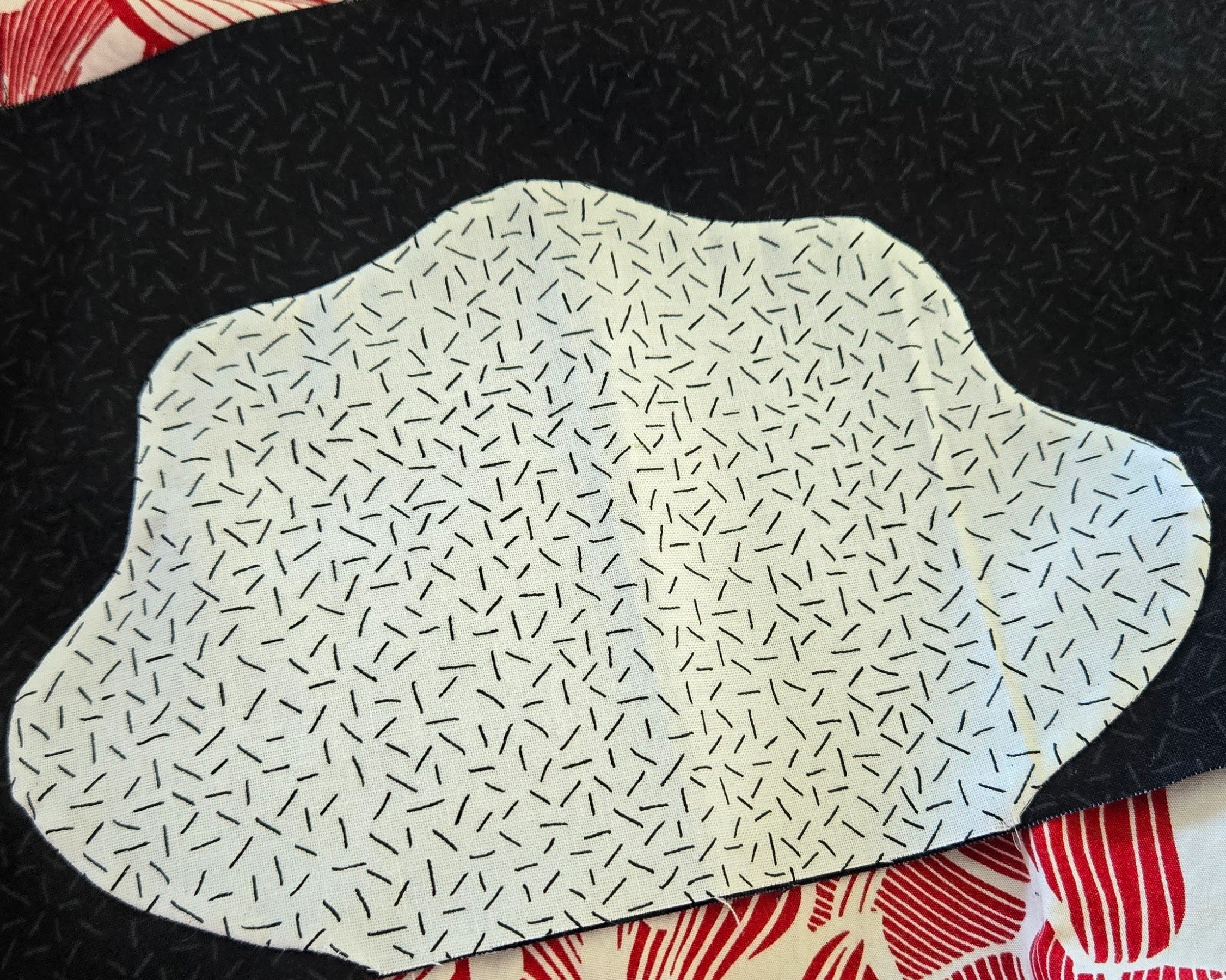
This is the coordinating cut center from the above white appliquéd on to a piece of black.

So these two blocks would NOT be paired together because the seam allowances would distort the Notan effect. I paired them with their coordinating cut with the black appliqués.

Clear as mud?

After I made my realizations and made the first sets of blocks it was clear that I wanted to make more. And more. It took a little planning to make the sizes work because I had cut my first blocks in a rather random and odd size (12.5” x 20.5”). To be honest, it took a lot more planning than I am used to! In the end, however, it came together with just the right amount of fabric before I ran out.

It is not a representation of the art of Notan, but I think the inspiration definitely shows. Now to figure out how I want to quilt it.
Quilted Baba Update

Confession: I had a hard time working on this project over the last year. The reasons are many and varied.

First, moving to the studio a year ago meant my Morning Make routine was upended. I only do handwork or writing at home now, for Morning Make. Then, when I arrive at the studio things aren’t always so smooth. At the beginning, my son was coming with me so he could do school online. I didn’t feel comfortable having the machine going while he was doing school so he had a fighting chance at concentration. Then, because the studio is attached to our company offices, I was often pulled into work work stuff. In the end, I struggled to find the dedicated time to work on these blocks.

Second, this is boring and repetitive sewing. Tiny Xs, squared up to 1.5” x 1.5”. There are 100 in each block and the whole quilt requires 81 blocks. A girl can only do so much before it drives her to madness. And, let’s be honest, it’s a short drive these days as I struggle through perimenopause.

All that being said, I have no doubt that I will finish the quilt. It's too important to me not to.

In the last month I’ve pulled it back out. My son is finally back in school full time, so that barrier is removed. I also have my own means of transportation again, which means my mornings are no longer heavily influenced by my husband’s schedule. So I can come in when I want and sew before anyone knows I am here, minimizing the company interruptions in the morning. It’s not perfect, but I am getting more consistency.

One stitch at a time, one stitch at a time.

I usually make 10-20 little squares each day. Then it takes a few hours to put an entire block together, mostly because of all the pressing! One day, when I know I have the time, I will try to make a block from start to finish and time myself. If only to satisfy my curiosity.

The truth is, there is no need to put pressure on myself. This was never going to be a fast project, there is way too much piecing for that to happen! This is about persistence, not patience.

Book Cover Quilts

Join me for this crazy little exploration in quilt blocks.

For each book I read in 2025 I am making a quilt block inspired by the cover. Not necessarily by the book or the story itself, but by the cover. So it is really a block inspired by the book designer’s work. And they would have been guided by the contents of the book. Sometimes the covers use original artwork, created just for this purpose, sometimes they pull from existing artwork.

Credit where credit is due - for both the book designers themselves and the woman who gave me the idea for this project. Margaret Fleisher did a similar thing for a 100 day project a few years ago. She is a great improv quilter! I was enamoured with her idea then and am doing my own version now.

I’m not here trying to make a literal interpretation of the book cover. Knowing that I am playing improvisationally I just try to capture the feel of the cover. Not every detail is included, and rarely is the text even referenced.

For example, for The Heaven and Earth Grocery Store above (amazing book by James McBride!) I used the illustration made by the designer Lauren Peters-Collaer as my started point. I picked fabrics from the scrap bin that were similar. To be honest, I debated going a bit more abstract as the human figure can be tough to translate, depending on the posture, and this posture is not an easy one. I am so glad I pursued the play! Of course, it is not exact, but it does have a clear relationship.

Don’t tell the others, but it is my favourite of the blocks so far! Probably also my favourite book of the year.

Someone on Instagram asked me if I was choosing books based on the covers. Nope! I read all sorts of books and choose them based on my mood more than anything. If you look at the books I’ve read this year I have memoir, literary fiction, historical fiction, cozy mystery, cozy Japanese, history, and more. I do consider audio books reading, so they might make the list too. Here are the books so far in 2025:

  • Moon Road by Sarah Leipciger, cover art by Grant Haffner

  • The Best Kind of People by Zoe Whittle, cover design by Alysia Shewchuk, image by Xavier Noel

  • Sunshine Sketches of a Little Town by Stephen Leacock, cover illustration by Alessandro Valdrighi

  • This is the Story of a Happy Marriage by Ann Patchett, cover design by Robin Bilardello

  • The Wager by David Grann, narrated by Dion Graham (this one is absolutely worth the audio book version)

  • The Maid by Nita Prose, cover by Elena Giavaldi

  • What’s Mine and Yours by Naima Coster, cover by Sara Wood

  • The Sleeping Car Porter by Suzette Mayr, cover by Ingrid Paulson from art by Janet Hill

  • Crook Manifesto by Colton Whitehead, cover by Oliver Munday

  • The Comfort of Crows by Margaret Renkl, cover design by Charlotte Struck, with art by Billy Renkl

  • The Heaven and Earth Grocery Store by James McBride, cover by Lauren Peters-Collaer

  • The Blanket Cats by Kiyoshi Shigematsu, translated by Jesse Kirkwood, cover by Vi-An Nguyen

I’m not the kind of person who sets reading goals. As long as I read every day - even if only for a few minutes before bed - I am content. I usually keep a list of books read for the year and I finish about 20-30. So I am looking at the this list and kind of surprised I am already through a dozen!

For the blocks, I wait until I’ve finished 3 books, then I make the 3 blocks. It becomes a little afternoon of playtime and remembering the books. If you want to follow along a little more ‘live’ then make sure to check out Instagram. As for what I will do with the blocks? That remains to be determined.

Quilted Baba Update

Large quilt block of pink, grey, and cream squares from a pixelated image

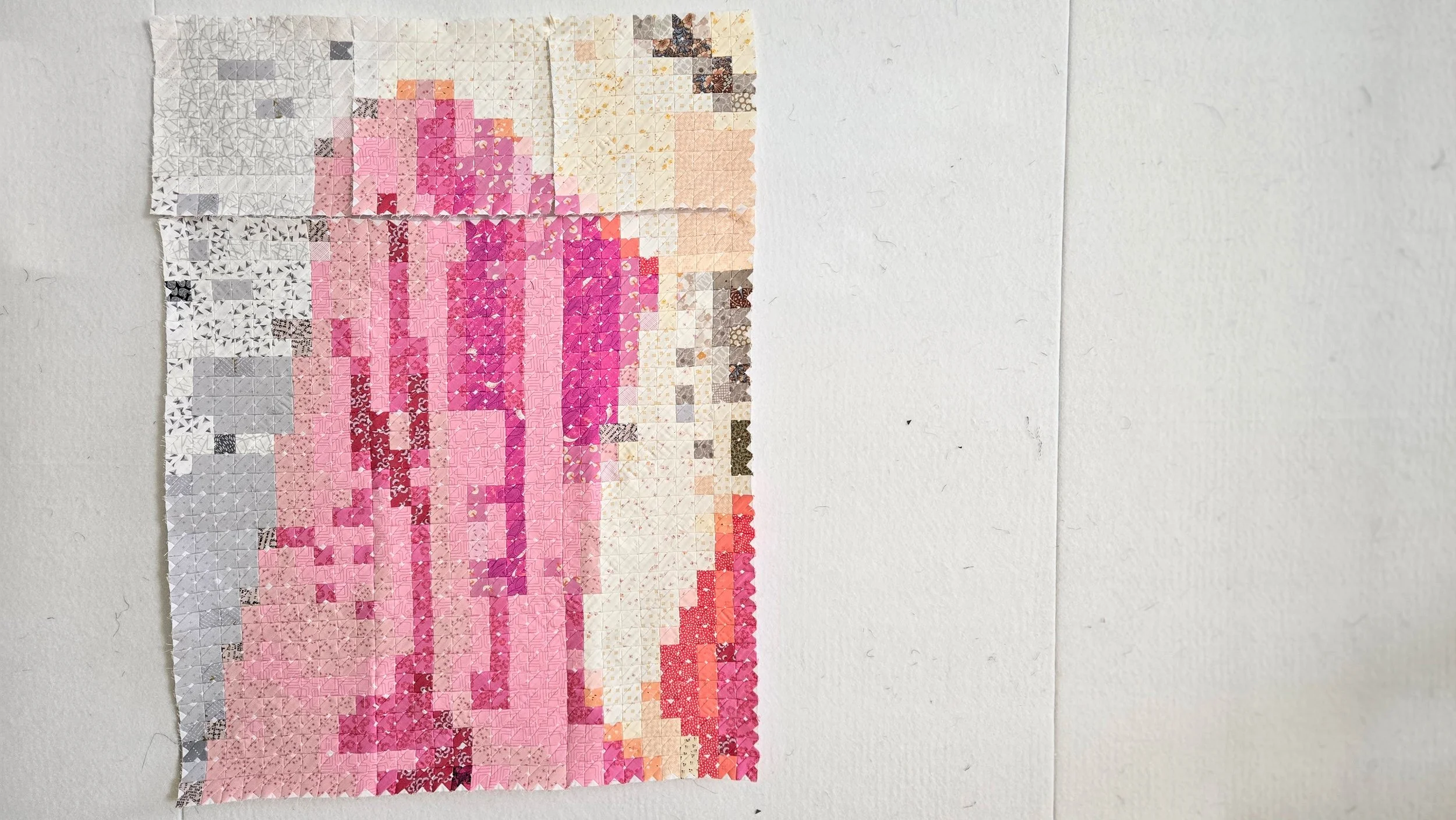
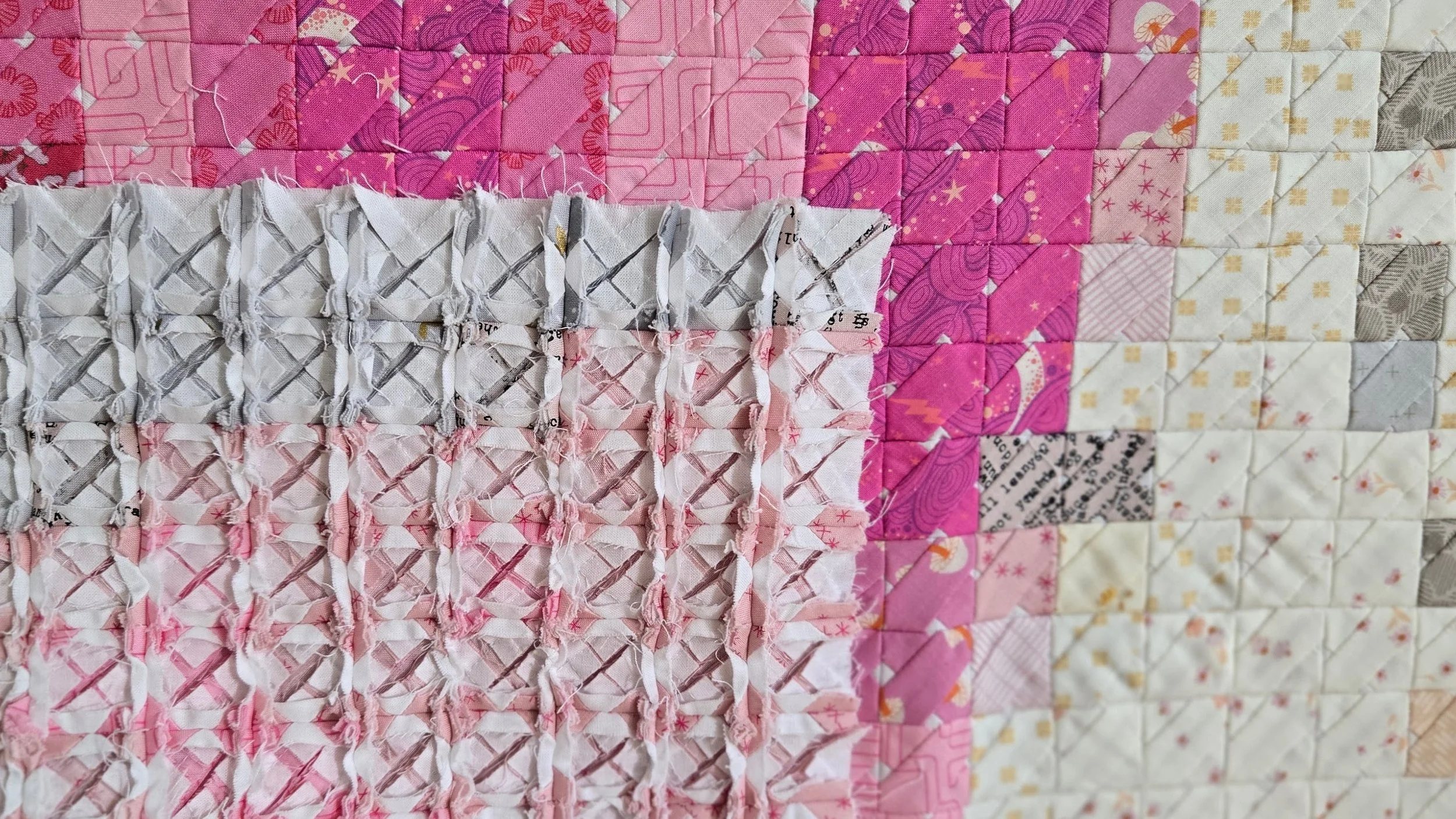
Making progress over here. It’s slow, but it is progress. This is the first 9/81 blocks, all sewn together.

Early in the year I let you in on this epic portrait project. It is a pixelated quilt portrait of my Baba. Each pixel is actually a little x block. And when I say little, I mean that I square them up at 1.5” x 1.5”. When all is said and done, the quilt will measure 90” x 90”. To make the quilt I’ve divided the picture I started with into a 9 x 9 grid. Each of those 81 blocks is made from 100 of the little X blocks. That means there will be 8,100 little cross stitches in the finished quilt.

That picture there? That is 9 of those 81 blocks of 100 together. They constitute the bottom corner. Why did I start in the bottom corner? Well, I had to start somewhere! It also allowed me to test the fabric choices and pixellation because all the other corners were mostly background colours. I’m happy with how it turned out so I shall keep going!

Small pile of taupe quilt blocks with an X pattern on a green cutting mat

For the most part, I’ve been making the blocks as my Morning Make practice. I tend to make them in batches of 10-15. It is tedious and boring sewing, so that seems to be all I can handle. That, and the fact that it was in the morning and there is only so much time to sew. When I have 100 for the block I lay them out and start the process of sewing them together. Assembling rows goes quickly, but the pressing is a definite slow down in the process. It’s worth the time and effort, though, as there are a lot of seam allowances and having a mess on the back is not good. With such small pieces a messy back would spell disaster for a quilt that stays flat and in order. Once the rows are sewn I pin - yes, me, pinning! - to join the rows together. I want them to line up as best I can. I will admit, there is a some work needed on my part to improve accuracy. But it improves with each block.

Now that I have the studio space I have to figure out a new time to piece these blocks. I think a regular time would allow me to see continued progress, and make it harder to put things aside for weeks or even months on end. So far I’ve been taking 20 minutes after lunch, after I walk with my son and the dog to school. We’ll see how that works.

I think it is important to tell myself that this won’t be an exact representation of the photo. I did my best to match colours and fabrics, but we are always limited by what is available. I wanted to use prints, which meant buying commercially available fabric. I fear that my work with the values, more than the colours, isn’t exactly spot on. I know, however, that the story of the quilt will still be successful. For me, that matters more.