"tips and tutorials"

Snippets on Dates


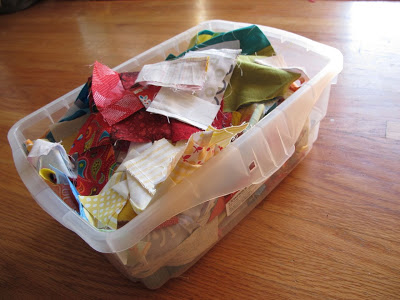
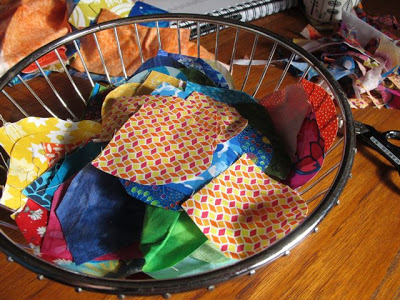
For the last two or three years I've kept this bin of fabrics scraps by my side while I sew. It sits next to one of my big glass jars full of seemingly useless snippets of scraps. Tiny pieces, big pieces, odd pieces. They all live together in the hopes of becoming something more.

Slowly, slowly, they are indeed doing that.

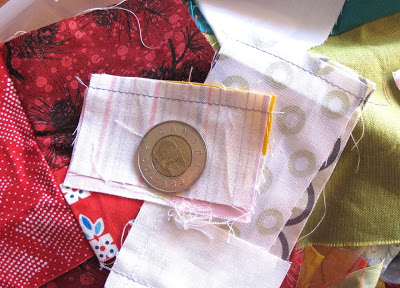
As I sew, particularly improv sewing, I use these little bits as leaders and enders. That is, instead of having dangling threads on every single seam I often grab two snippets and sew them together. At the end of a moment of sewing I have a new collection of pairs.


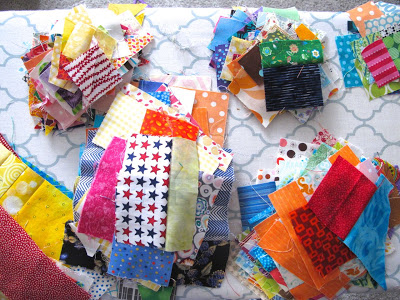
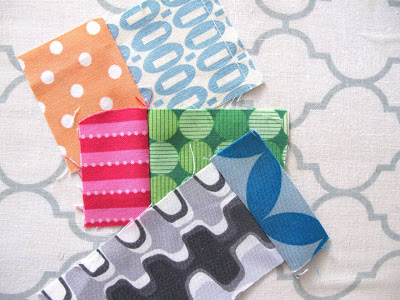
Some pairs are small, some a bit larger, and some teeny tiny. Eventually, they will all get sewn together into some kind of crazy, hot, scrappy mess. And I will love it. For now, however, they are still sitting in pairs, like some sort of speed dating event.

On the weekend I wasn't in the mood to sit while we watched UFC and Le Tour at the end of the night. So I set up my iron and finally tackled the pressing of these lonely dates longing to be part of the crowd. And three hours later I wasn't quite done, but I made a good dent.


Now it is time to create a new set, by sewing these piles together. And so on, and so on... It really is going to be chaotic when done, but I'm pretty sure I'll love it. How can I not, when I have these little precious combos littered throughout?


Keep these leaders and enders in mind when you're making your slabs. Makes the process faster and neater.

Ten Tips for Machine Quilting Large Quilts


Still quilting...

Yes, I'm working on a king sized quilt on my home machine. Some of you expressed surprise at that, some wished me luck in that kind of evil way where you don't actually believe I can do it. Or at least it seems so incredulous that it comes across that way. I get that, I totally get that. But I'm here to tell you that it is totally doable. You just need a few tricks up your sleeve.


1. Have support.
Not the kind that stands behind you and cheers you on as another row of stitching goes in, although that is indeed helpful. Rather, make sure your quilt if physically supported by a table, your body, the wall, etc. You don't want your quilt hanging off the table and pulling as you try maneuver it through the machine. For this one I've kept my table against the wall instead of the middle of the room to make sure the quilt doesn't fall off the edge.

2. Break it down into smaller sections.
It is daunting to stare at a large quilt and even think about quilting it. Break it into sections, even if it is only mentally, to make it seem more manageable. Perspective is everything. And just like when you are trying to lose weight and you reward yourself as you reach 10 pounds of the 40 you need to lose, give yourself a treat as you finish a section.

It also helps to approach the quilting in sections so that you can roll, fold, and position the quilt for each section. This makes supporting and moving the quilt easier.

3. Have a beer.
Or a glass of wine or even a stiff scotch. People often say that having a bit of a tipple helps loosen you up for free motion quilting. Even if you are doing straightline stitching on a large quilt, being a little loose helps. And having to stop and move your arms in another direction is a very good thing. If water or tea is your preference, keep something by the machine. Quilting is thirsty work.

4. Take breaks.
Big quilts are heavy, very heavy. It takes a lot out of your shoulders, neck, and upper back to quilt these beasts. I can do about an hour at a time before I feel the tightness creep in. Then I have to get up, stretch, do a load of laundry, or actually attend to the kids. I feel like I accomplish a lot when I get a solid hour in but my body feels it.


5. Prewind bobbins.
Having a bobbin run out is inevitable. And while the bobbin change is a good time to stretch and take a break, it can seriously disrupt your rhythm if you are in the groove. I wind 4-5 at a time on these large quilts. It's just nice to be able to grab and go when a change is needed.

6. Keep clean and sharp.
Every time you change your bobbin clean out any lint from the bobbin casing or around the needle. And speaking of the needle, you will definitely need more than one on a large quilt. I tend to change mine every 6 hours of quilting or so. I want a sharp needle and clean machine. It means less headaches while quilting and better results.

7. Raise it up.
It is a lot easier to quilt on a large flat surface. I have a special plexiglass table that is made for my machine that gives me a large surface to quilt on. If you can get one for your machine, definitely do it. Or if your machine drops into a table, great! (Just make sure the table is big enough to support the quilt, or add side table while quilting.)

8. Sit higher.
Without 1-2 pillows underneath my butt while quilting I find that I am too low to be comfortable, especially once I've put my quilting surface on the machine. But raised up a little saves my neck and stops me from hunching horribly. If you are getting really sore, try sitting up higher.

9. White noise.
Yes, the sewing machine is noisy but I need more noise while I'm quilting. Music is great (and oh so necessary for piecing) but I prefer TV while quilting. Not TV I need to really pay attention to because that is too distracting. Movies or shows I've seen are best - like a friend keeping you company. For example, I've had Downton Abbey on while working on this beast. A third of the way through the quilting and down Season 1 and a few episodes of Season 2.

10. Don't forget to breathe.
Seems obvious, I know. But I am not immune to the tendency to hold your breath as you do a pass with the machine. Push the pedal down, hold breath. Release the pedal, breathe. It's a bad habit and one that is necessary to break. Even breaths as your sew keeps your mind and muscles working well.

Don't let the size of a quilt scare you from quilting. You can do it!

How Do You Finish Your Quilt Bindings?


Okay, I've got a question about binding. In between finishing up my daughter's quilt and some surfing I've been thinking about binding a lot the past few days. Plus, it was a nice distraction from the real world.

Machine Binding
- Can finish on the front or the back.
- Very fast.
- Clean look, but with a very visible seam.
- Great for quilts that live primarily for trunk shows.

Hand binding
- I actually enjoy hand finishing.
- It feels like a very personal touch on a quilt.
- More or less no seam line on a finished edge.
- It does take some time.


Personally, I've tried a few methods for finishing binding. My preference is for hand-finishing, but I've got nothing against a completely machine bound quilt. I do machine binding on quilts that are not gifts - class samples, trunk show quilts, even some book quilts. Hey, when faced with a looming deadline a girl does what a girl has to do!

Let me be clear. I do not feel guilty about machine binding, nor do I judge anyone's method for binding.


One thing I have noticed, however, is that for those who hand finish, stitches seem really far apart. I see these perfectly flat binding edges that are stitched down. It's one thing to not see any stitches because the quilter is just that good. And there are many, many techniques for hand stitching a binding. But people, you need to put a stitch closer than every half inch! When we quilt we call those big stitches in the quilting itself "toe catchers". On a binding I would call that a disaster. That is the place a quilt wears the most and having large, maybe loose stitches is asking for a finger to pull it out at the first chance it gets caught.

I'm perfectly willing to admit that I'm rather anal about my own hand finishing  - having my stitches come in between 1/4'' and 1/8'' apart. So yes, this takes me some time. But I've also never had a binding come loose. This is my most common method for finishing, but I've used the ladder stitch and been pleased with the results. And I recently tried switching up my needle in placement - through the binding instead of the quilt back and liked the look and stability of that.


What about you? How do you finish your bindings?

Wine Gums in Progress


When we were writing the book I was in awe of Amanda Jean's quilts. She specializes in making use of the teeny tiny scraps. It's a great use of fabric, but all those pieces do mean that even a small quilt takes some effort. Don't be fooled by the size. You get great impact and an amazing use of fabric. And truly, it is hard to appreciate the scale of some of these quilts from the book.

It wasn't until we were giving our schoolhouse at Market that I could appreciate this. And now that I am out and about giving trunk shows I realize that I need to share these quilts to show more quilters the awesome opportunity presented by these designs. The first of Amanda Jean's little pieces quilts I'm tackling is Gumdrops.


I actually started this quilt in March, when I got my new scissors. And when cutting up little pieces of fabric was about all my big ol' pregnant body could handle. The little pieces then got put aside in favour of the baby and other work. But after my last trunk show I decided they needed return to daylight and be put to use.

Of course, I had to do things differently than Amanda's pattern. I have such a hard time following patterns. This time, however, it was unintentional.

In the pattern Amanda suggests fusing the scraps to a lightweight fusible BEFORE cutting the shapes. I neglected to read these instructions before I started cutting out my gumdrop shapes. That meant I would have to add fusible in tiny pieces, after the fact. That bit of work did not appeal to me. But, I do think you need some stabilization of the pieces to the background prior to assembly.

This piece has you sew down your applique and quilt as one step, so the pieces need to be stabilized prior to basting.


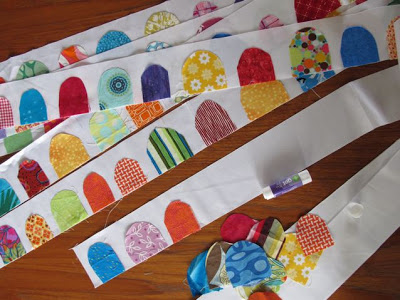
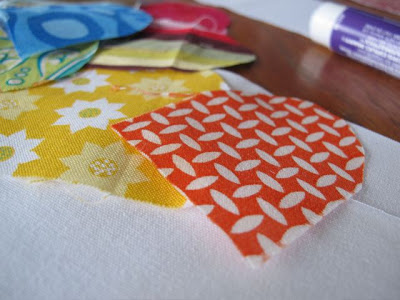
Instead of fusible I rummaged through the girls' craft supplies for a glue stick. Yup, a plain old glue stick. A little bit of glue on the back of each piece tacks it to the background. Then you can sew your strips together, baste, and quilt. As long as you don't coat the back there is no residue left after quilting and washing. You also don't get the stiffness associated with even a lightweight fusible.

As a bonus, this becomes a craft project with a bored preschooler missing her big sister at school all day. An excellent alternative to the endless tea parties.