"tips and tutorials"

How Do You Finish Your Quilt Bindings?


Okay, I've got a question about binding. In between finishing up my daughter's quilt and some surfing I've been thinking about binding a lot the past few days. Plus, it was a nice distraction from the real world.

Machine Binding
- Can finish on the front or the back.
- Very fast.
- Clean look, but with a very visible seam.
- Great for quilts that live primarily for trunk shows.

Hand binding
- I actually enjoy hand finishing.
- It feels like a very personal touch on a quilt.
- More or less no seam line on a finished edge.
- It does take some time.


Personally, I've tried a few methods for finishing binding. My preference is for hand-finishing, but I've got nothing against a completely machine bound quilt. I do machine binding on quilts that are not gifts - class samples, trunk show quilts, even some book quilts. Hey, when faced with a looming deadline a girl does what a girl has to do!

Let me be clear. I do not feel guilty about machine binding, nor do I judge anyone's method for binding.


One thing I have noticed, however, is that for those who hand finish, stitches seem really far apart. I see these perfectly flat binding edges that are stitched down. It's one thing to not see any stitches because the quilter is just that good. And there are many, many techniques for hand stitching a binding. But people, you need to put a stitch closer than every half inch! When we quilt we call those big stitches in the quilting itself "toe catchers". On a binding I would call that a disaster. That is the place a quilt wears the most and having large, maybe loose stitches is asking for a finger to pull it out at the first chance it gets caught.

I'm perfectly willing to admit that I'm rather anal about my own hand finishing  - having my stitches come in between 1/4'' and 1/8'' apart. So yes, this takes me some time. But I've also never had a binding come loose. This is my most common method for finishing, but I've used the ladder stitch and been pleased with the results. And I recently tried switching up my needle in placement - through the binding instead of the quilt back and liked the look and stability of that.


What about you? How do you finish your bindings?
Wine Gums in Progress


When we were writing the book I was in awe of Amanda Jean's quilts. She specializes in making use of the teeny tiny scraps. It's a great use of fabric, but all those pieces do mean that even a small quilt takes some effort. Don't be fooled by the size. You get great impact and an amazing use of fabric. And truly, it is hard to appreciate the scale of some of these quilts from the book.

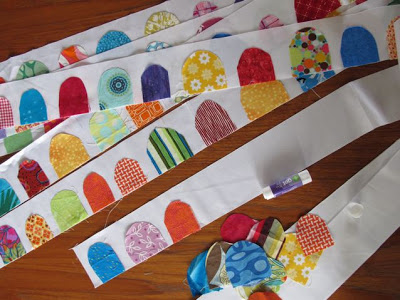
It wasn't until we were giving our schoolhouse at Market that I could appreciate this. And now that I am out and about giving trunk shows I realize that I need to share these quilts to show more quilters the awesome opportunity presented by these designs. The first of Amanda Jean's little pieces quilts I'm tackling is Gumdrops.


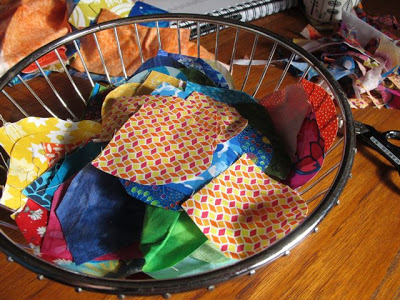
I actually started this quilt in March, when I got my new scissors. And when cutting up little pieces of fabric was about all my big ol' pregnant body could handle. The little pieces then got put aside in favour of the baby and other work. But after my last trunk show I decided they needed return to daylight and be put to use.

Of course, I had to do things differently than Amanda's pattern. I have such a hard time following patterns. This time, however, it was unintentional.

In the pattern Amanda suggests fusing the scraps to a lightweight fusible BEFORE cutting the shapes. I neglected to read these instructions before I started cutting out my gumdrop shapes. That meant I would have to add fusible in tiny pieces, after the fact. That bit of work did not appeal to me. But, I do think you need some stabilization of the pieces to the background prior to assembly.

This piece has you sew down your applique and quilt as one step, so the pieces need to be stabilized prior to basting.


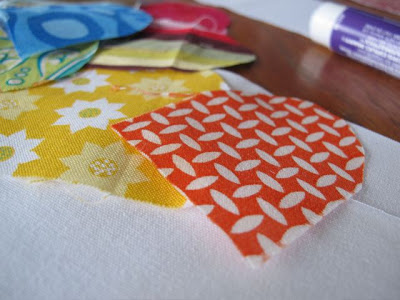
Instead of fusible I rummaged through the girls' craft supplies for a glue stick. Yup, a plain old glue stick. A little bit of glue on the back of each piece tacks it to the background. Then you can sew your strips together, baste, and quilt. As long as you don't coat the back there is no residue left after quilting and washing. You also don't get the stiffness associated with even a lightweight fusible.

As a bonus, this becomes a craft project with a bored preschooler missing her big sister at school all day. An excellent alternative to the endless tea parties.

Kinda Herringbone


Kinda Herringbone
60'' by 80''

This is my latest finish, my Shades of Grey quilt. And guess what? I'm offering it as a pattern for sale! You can get it at my new Etsy shop.


If you've been reading here for any length of time you know that I will always encourage other quilters to do their own thing. To take an idea, inspiration, or even a pattern and make it their own. This pattern is written that way. It provides the technique and the basics to make a quilt like this, but I also provide tips on making your own size, your own colour, and even with variations in design. Of course, that's not to say you won't make it a way I haven't even thought of! Or that you don't love it as is and want to make it exactly like this quilt.

This quilt and pattern wouldn't exist with the support, inspiration, and work of Jan DeCinto, the force behind Daisy Janie. The design itself was inspired by one of the fabrics in her Shades of Grey line and she helped me tremendously in getting the pattern itself together. To pick up her fabric check out her list of retailers.


A few more details on this particular quilt:

- The top is entirely made from Shades of Grey organic fabrics.
- I used a bamboo batting to try something different.
- The back is made up of wide strips of Kaffe Fassett shot cottons. I chose those intentionally to have a lighter material on the back. With a foundation fabric in the top I wanted to lighten up the quilt overall.
- It is quilted with an organic thread.
- Pieced binding with Kona organic solids.


Thank-you, readers, for continuing to inspire and push me to be a little bit more than I was yesterday.

Quilt Snob?

Am I a snob?

Okay, don't answer that right away.

There has been a lot of talk and entertaining posts lately about a lot of quilt arena issues - modern versus traditional, rants about designers, plain old rants, beginners feeling shamed, quilters being snobby, and more. I'm not going to repeat them all here, and I doubt I've even seen them all. But if you want some really interesting posts read them here, and make sure you read all the comments too. Note: I've included different opinions here, only this post is my own.

It is actually the comments I'm reading that are pushing me to write this post. Many folks are upset with "quilt snobs". Unfortunately, it isn't always clear to me what defines a snob.

The way I define a snob is someone who intentionally works to make someone else feel bad for the way they act, dress, define themselves, propping themself up higher on their already high horse in doing so. When it comes to quilting snobs, what does this mean?

... Disdain for one style of quilting over another?
... Talking smack about a fabric line you aren't a fan of, and by extension, the designers?
... Shooting down bloggers who maybe don't have a fancy camera or can only take their pictures late at night when they have a spare moment to work?
... Judging people who are trying to make a living at quilting?
... Being openly critical of bee participants?
... Just another name for the quilt police marking down missed points and skipped stitches?
... Big Name Bloggers refusing to comment on other blogs?
... Groups of friends that are collaborating/chatting and defined as cliques?

I've been critical of charm packs/pre-cuts and the reliance on them. I struggle with group projects where the simple quality of the workmanship is lacking (ie. no 1/4 seams, lack of pressing, and no squaring up of blocks). I'll admit that I'm tired of plain patchwork quilts. And stippling. (I've done more than my fair share of both)

All this, however, doesn't make me a snob. Anytime I think these things I keep my mouth shut (until today, obviously). If I visit a blog I like and see a quilt I don't then I move on to the next one in my Reader. I like to challenge myself so that's why you don't see me do many things twice, but that's me. I have no interest whatsoever in making someone feel bad or trying to make myself feel better with an off-putting or off-colour comment.

I will never condemn you for your pattern choice. I will never judge your fabric choice, but I will share my considered opinion if you ask. I will never shoot someone down in a public forum for their own creativity, work, family, or anything quilty related.

Rather, I want more people quilting. I want blogs to inspire. I want new or hopeful quilters to come to blogs and think "I can do that!" Or, if they are intimidated by the work (and not the quilter) think, "I can't wait until I can do that!" I don't think I'm alone with this goal. I want people to feel motivated to finish their quilts however they like, with the emphasis on finishing.

In pursuit of this goal I will continue to share my own inspiration, my work - both easy and difficult - tips and tutorials and yes, challenge the conventions. I will always encourage people to break free from patterns, charm packs, and single line quilts. I will always, always stress care in construction. I will always answer questions you send my way. I will push for people to be open with their process

This doesn't make me a snob.

Or does it? Be honest, I've got skin as thick as an elephant. But remember, my Dad just died.

(That was a joke.)

What makes a quilt snob? Have you had any run-ins? What's your strategy for dealing with the quilt snobs you encounter?