"teaching"

Upcoming Classes Spring 2011

Interested in some modern quilt classes in the Calgary area? I've got two coming up at, of all places, Traditional Pastimes. It only sounds ironic in name, Bernadette is a great supporter of modern quilting and brings in some of the best new fabrics to hold court next to civil war reproductions.

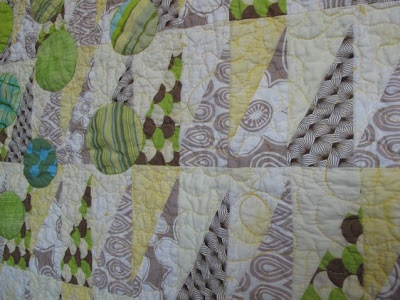
Want to learn about Values Quilts and perfect your half-square triangle technique? This will be a one night class to get you set. We'll discuss ways to see and use value, make-up a set of blocks, then play with settings.

Thursday, April 14
6:30-9:30 pm


How about Improv? I've made a few adjustments to my Improv class. Not only will we be practicing different techniques for improv blocks, like a wonky log cabin and free piecing, we also tackle the challenges of breaking free from precision cutting and patterns.

Monday, May 2 and May 9
6:30-9:30 pm

To register for either class contact Traditional Pastimes.

Personality


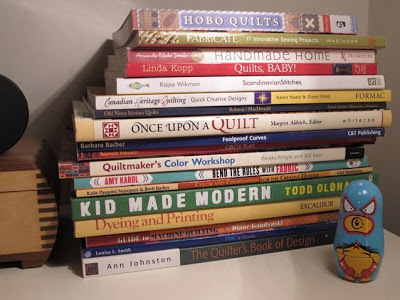
Let's talk books.

I've reviewed a few books here and plan to review a lot more in the coming months. Before I go any further I wanted to bring up a conversation here.

There was a comment on last week's post by Weeks Ringle, one of the authors of The Modern Quilt Workshop, among others. Her comment led to a series of emails between she and I about the writing in quilt books.

I'm a fan of good writing. Just like I'm a fan of a cup of strong tea, colour, and the Edmonton Oilers. I also enjoy entertaining writing, or a piece that challenges or motivates me. While I've only read a couple dozen or so quilt books in my time I can say that it isn't always the writing that attracts me to the book.

Too often, a quilt book is a section outlining the concepts of the book - what makes this book different from all the rest of the books out there - followed by a basics quilting section. After that it is a bunch of patterns. The vast majority of books are glorified packages of patterns.

To be clear, I don't actually see anything wrong with that. I don't own many of this type of book, but they serve a purpose and can be quite motivating. What makes a book buyable and frequently browsed - to me - will be the good writing.

If I flip through a book and the patterns are interesting or exciting to me the first thing I do is read the Introduction. Bad or boring writing usually causes me to set the book down. I'll probably take a mental note of what I liked from the patterns and file it away for later inspiration. If the writing is engaging or grabs me with a challenging concept I am far more likely to take the book.

Of course, I'm also a sucker for pretty and clean layouts.

This leads me to what Weeks Ringle and I were chatting about - what is the appropriate level of personality in a book? The visuals, aside from the quilts themselves, are a strong part of the personality of the author. Compare Simplify with Camille Roskelly with The Practical Guide to Patchwork by Elizabeth Hartman, for example. Same publisher, same book format. But visually they are very different.

The writing is also part of the personality. And making the writing personal is about more than adding a whole pile of exclamation points or silly jokes. Being able to write in a voice that sounds like you when you are talking doesn't come to everyone. More importantly, being able to do so well and still be engaging is a big challenge. Even if you can do it well, it is hard to be great at it all the time.

In a book that is outlining specific concepts or technical design information, is there a place for personality? That was the question Weeks and I were debating. Or it is better to be succinct and specific?

This, of course also leads to the inherent links between blogging and books. Are they separate? Should they be? If you blog and write a book, how much of one should make it to the other - marketing aside?

I'm going to turn it back to you now. You've read the questions above. You've probably read a million books on your own. What are your thoughts? Oh, one more question. What is your experience as a quilter and what type of books do you like to read?
What Does Modern Quilting Mean to Me?


Over at The Modern Quilt Guild this week they've had a series of posts from some significant bloggers in the the modern quilt movement. I've rather enjoyed the conversation, so I decided instead of just commenting on all the posts, I would create my own post. So, what does modern quilting mean to me?

Central to modern quilting, I believe, is the idea of Freedom. Unlike traditional quilting which can feel very restrictive in both construction and design, modern quilting is about freedom. Freedom to throw tradition out the window or tweak it with fabrics, layouts, and improvisation. Freedom to try something new in colours or construction. Freedom to do what you want without fear of the quilt police knocking down your door.

Improvisation is also central to modern quilting.  This doesn't just mean the wonky log cabin. Improvisation is about starting a quilt and seeing where it goes, without a detailed plan. Maybe you could also talk about process here.  When I was asking you about The Whys of quilting, process was something that was central to me at the end of that discussion. I think modern quilting stresses the process as much as the final product (regardless of your technique) and improvisation is central to many a modern quilter.

Even when a modern quilter is using calm colours or simple designs, The end result is always something quite bold.  It might the fabrics themselves, or the final design, but when I think of modern quilts, subtlety does not come to mind.

I know that there are many traditional quilters out there under the age of 40. And there are modern quilters out there over the age of 50. But when I think of modern quilting I tend to think of youth. Perhaps it is because there is an energy to the work and the movement? It might be because most (but not all) of the bloggers I've encountered are closer to my age than my mom's age? But that youthful enthusiasm and energy has, I think, a powerful influence on the quilting world as a whole.

It would be remiss to not mention the role of technology in modern quilting. I don't just mean the design software. Blogs, virtual quilting bees, Flickr, and Etsy are all having a powerful influence on quilting. Have you heard of Web 2.0, where we the readers are also the content providers and help determine the present of the internet? Well, technology has allowed us to have Quilting 2.0 as well. Not only are we connecting and working together in a way that wasn't possible beyond the traditional guild, we are also working with each other projects, lending opinions through workshops and our blogs, and generating a never ending cycle of inspiration.

Finally, I want to highlight, that for me, it is important not to throw out the baby with the bath water. That is, there is a lot in traditional quilting that shouldn't be thrown away just because we like a modern aesthetic. This includes basic technique - we still want a quality piece at the end, not just one that looks good in a small on-line picture.  It also includes colour theory and design basics. We're modern and it is up to us to push the boundaries a little. Like modern architecture though, the building still has to stand on its own.

In a somewhat contradictory twist to this conversation I will be attending my first guild meeting tomorrow, a traditional guild. I'm quite excited about it, and it seems that this guild has some modern tendencies and vibrant members. With The Modern Quilt Guild springing up across North Amercia, maybe one day there will be a Calgary chapter?

The Whys

Since the creative production here isn't all that high, I've been thinking a lot about creative production. For me, that means writing and quilting. Over the course of a few conversations with a good friend we've asked each other about style, why we quilt, and what we think of when we talk about quilting.

Today I am going to address the last question.  It's kind of a word association game. 
When you think of quilting, what words come to mind?

For me, quilting means:

Creativity
Uniqueness
Comfort
Colour
How
Those were my first instinct words, what are yours?