"improvisation"

Fear

Fear holds a lot of people back. Not only in life, but also in quilting. Fear of a new technique, fear of messing up, fear of being less than perfect, even fear of not being liked (the work, that is). I'm here to tell you to stop being afraid.

(I feel evangelical just typing that. Maybe I should be on a stage with a tiny microphone on my face and gesticulating calmly as I speak. You know, projecting a voice of inspired energy and turning you over to my side?)

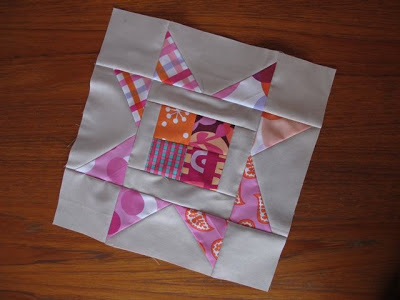
This is a bee block. Just a simple wonky star with a twist was requested. I can get those directions, play around with the fabric given, and come up with something a bit different from the typical stars seen out there. For another person, those directions can simply stop them in their tracks. For one, saying wonky paralyses many. Must have a straight lines... And two, this begs for improvisation. Must have a pattern... Finally, what if the recipient doesn't like what I do?

For a long time I didn't understand these fears. In my case it was because I happen to like a challenge and actually sewing that way. But then people asked me to sew very precise things in their bees, with very specific instructions. Definitely not my go-to-choice for a project. But I'd made the commitment to the bee and my fellow participants. And I wasn't afraid so much as less than excited. But it's one block, what's the big deal?

But one block can be a big deal to a beginner, or to someone whose never made a triangle or not worked with a pattern. I don't want it to be a big deal though. I want people to look past those fears and relish the challenge. Why not try something new? Do you want to make log cabins or simple patchwork for the rest of your life?

Okay, maybe you do. Maybe you would be really happy churning out those quilts. And that's fine. But then stay away from on-line bees and expect other people to get bored with your work if you choose to share it with a very public audience. That's all good if you are happy doing what you are doing.

Looking for more, though? Feeling inspired by all you see on-line or at guild? Then it is time to set aside some fear. Here are some tips to get you moving past the fear:

- Join an on-line bee. This will force you to try new techniques and meet other quilters. Alternatively, join a round robin or guild bee.

- Play. You can just sew for the sake of sewing, it doesn't have to turn into anything.

- Don't blog about it. If you are worried about what people think, then don't share it.

- Blog about it. Push yourself to put it out there, flaws (perceived or real) and all.

- When in doubt about that one fabric, include it. If it still niggles at you once you've used it, then take it out. It is only fabric.

- Ask for help. Whether from an in-person friend or by posting on-line, seek input from others (like we did with the Workshop in Progress).

- Challenge yourself. Set up regular goals to try new techniques or colours.

- Stop reading blogs and books for a little while. It can be demoralizing for many to see so much inspiring work. That is, we think we can't be good enough or think it is beyond us. So take a little retreat for yourself and turn off the computer and stay away from the stack of books. Fondle your fabric and sew for yourself.

- Colour. Stuck when it comes to fabric? Then pull out the crayons, markers, or pencils and just colour. Even if it is just a colouring book, go for it. Give people blue skin, colour the trees purple, or make polka-dotted dogs.

Keep in mind that if you are stuck there is no need to make an entire quilt to move past the fear. Make one block, just play for a bit. This reduces the commitment and moves your forward one step, one block at a time.

What other tips do you have for facing the fear?

Making Do

We are 4 people and 2 dogs living in 1100 square feet. Out of our dining room we run the home and two businesses. In theory, there is a basement reno underway. It moves in fits and starts, but it still generally moves forward, sort of.

Last year I was using my fence as a design wall. But to be honest, that's rather annoying when you are trying to actually sew from it. So when Hubby gave me the day off weeks back I rigged up this temporary design wall.

This is the wall between our kitchen and dining room. Since I sew at the dining room table this set-up worked great.  Well, except for one large detail - I kept walking into the chandelier.

Belated Easter Treats


How very Martha of me. Not that I dyed Easter eggs using cabbage, beets, onions, and turmeric. Not that I also decided to dye some fabric. But the colours are all Martha. And if you look around this site for about five minutes you'll see that I don't generally work in softer colours. Like I always say, it's good to change things up a little.

We dyed eggs with friends on Friday. I was totally enamoured with the colours, and very surprised from that orange from just a few onion skins. So I left all the eggs with our friends, but took home the rest of the dye juices. We dyed a few more eggs but that liquid colour looked too good to throw away. I already had all my scraps out so I grabbed some pieces of white on white and threw them in the bowls. The orange is from onion skins, the yellow from turmeric, and the purple measuring cup contains the liquid from boiled red cabbage.

This is the fabric as it came out of that red cabbage juice. Such a lovely purple. It clearly turned the eggs blue, so this was a bit of a shock. But a good rinse in cold water and some air time to dry and the fabric all turned the same soft blue/grey as the eggs. Perhaps a little less blue.

These are the turmeric stained fabrics right out of the dye water. So yellow! And even though I rinsed and rinsed they stained quite bright. And point of fact: turmeric dyed fabric will smell like turmeric long after it is rinsed and dried.

Look at my strips drying so nicely together!

And here are the eggs and their associated fabrics. In truth, they may be Martha colours, but they really are softer versions of the colours already in our house, namely turquoise and orange.

So I took all the scraps, trimmed them into strips, and started sewing. I went for the silly a little, in making an egg shaped placemat. This was easy to do. I simply created an egg shape out of paper so I had something to compare to as I sewed. You could also use it as a paper pieced project. Then I sewed the strips together. Once I knew I had my desired size I trimmed the top, cut out backing and batting and sewed it all together with right sides together.

Full disclosure, I screwed up twice when sewing it together. That's what I get for rushing to get it done during naptime. But I got myself sorted out and finished it off after turning it all right sides out and sewing that last seam around the edge.

There is a peak of the backing fabric. I put on something bright and fun so that if/when the top gets wrecked/runs I can use the other side for springtime. And there is my Smilosaurus checking it all out.

What Does Modern Quilting Mean to Me?


Over at The Modern Quilt Guild this week they've had a series of posts from some significant bloggers in the the modern quilt movement. I've rather enjoyed the conversation, so I decided instead of just commenting on all the posts, I would create my own post. So, what does modern quilting mean to me?

Central to modern quilting, I believe, is the idea of Freedom. Unlike traditional quilting which can feel very restrictive in both construction and design, modern quilting is about freedom. Freedom to throw tradition out the window or tweak it with fabrics, layouts, and improvisation. Freedom to try something new in colours or construction. Freedom to do what you want without fear of the quilt police knocking down your door.

Improvisation is also central to modern quilting.  This doesn't just mean the wonky log cabin. Improvisation is about starting a quilt and seeing where it goes, without a detailed plan. Maybe you could also talk about process here.  When I was asking you about The Whys of quilting, process was something that was central to me at the end of that discussion. I think modern quilting stresses the process as much as the final product (regardless of your technique) and improvisation is central to many a modern quilter.

Even when a modern quilter is using calm colours or simple designs, The end result is always something quite bold.  It might the fabrics themselves, or the final design, but when I think of modern quilts, subtlety does not come to mind.

I know that there are many traditional quilters out there under the age of 40. And there are modern quilters out there over the age of 50. But when I think of modern quilting I tend to think of youth. Perhaps it is because there is an energy to the work and the movement? It might be because most (but not all) of the bloggers I've encountered are closer to my age than my mom's age? But that youthful enthusiasm and energy has, I think, a powerful influence on the quilting world as a whole.

It would be remiss to not mention the role of technology in modern quilting. I don't just mean the design software. Blogs, virtual quilting bees, Flickr, and Etsy are all having a powerful influence on quilting. Have you heard of Web 2.0, where we the readers are also the content providers and help determine the present of the internet? Well, technology has allowed us to have Quilting 2.0 as well. Not only are we connecting and working together in a way that wasn't possible beyond the traditional guild, we are also working with each other projects, lending opinions through workshops and our blogs, and generating a never ending cycle of inspiration.

Finally, I want to highlight, that for me, it is important not to throw out the baby with the bath water. That is, there is a lot in traditional quilting that shouldn't be thrown away just because we like a modern aesthetic. This includes basic technique - we still want a quality piece at the end, not just one that looks good in a small on-line picture.  It also includes colour theory and design basics. We're modern and it is up to us to push the boundaries a little. Like modern architecture though, the building still has to stand on its own.

In a somewhat contradictory twist to this conversation I will be attending my first guild meeting tomorrow, a traditional guild. I'm quite excited about it, and it seems that this guild has some modern tendencies and vibrant members. With The Modern Quilt Guild springing up across North Amercia, maybe one day there will be a Calgary chapter?