
"books"

Colouring Books

This week is all about colour. Perfectly appropriate with a fresh dusting of snow outside. Although, don't fool yourself, there is a lot of colour in a winter day.

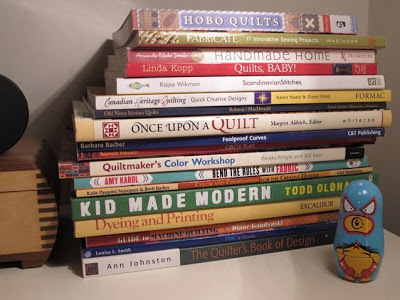
Elle asked for my favourite colour books. Colour books are not all the same. Considering colour theory transcends the medium of the maker and is fairly standard, this is somewhat surprising.

When it comes to quilt books and colour, the variations seem to come in the communication of the theory. I think this is great because people learn differently and one book may sing to you and fall flat for another reader. Okay, that may be personality, but when it comes to colour, it is probably more about how the message hits you. It isn't any fault of the writer either. It is all about what you, the reader and quilter, respond to in a book.

At the top of the list for me is Fun Quilts Quiltmaker's Color Workshop. They do provide a few short pages on colour theory, then launch into concrete examples of 15 different palettes. They aren't grouped according to analogous, complementary, split complementary, etc., like so many other books. Rather they talk about a concept, mood, or inspiration. Each palette includes a real quilt, illustrations of the colours used - including demonstrations of the proportions used - and where they fit on the colour wheel. Then they include illustrations of what happens when you change proportions or vary the colour choices. Finally, they suggest exercises or workshop ideas for the individual or group. And this is for each of the 15 palettes.

I think the way the book is written can appeal to many different types of quilters and learning styles. It is incredibly detailed in discussion and in visual illustrations. It isn't a book you are going to pull out to see if this green goes with that purple on the colour wheel. It is, however, a great book for pushing you to examine your colour use and to encourage you to play with fabric and colour before you even bring out a needle and thread.

Another great book to push you through some challenges is Color and Composition for the Creative Quilter by Katie Pasquini Masopust and Brett Barker. This one isn't just about colour, they also cover layout, balance, and composition. Moving the reader through a whole bunch of exercises, they really encourage the personal adaptation of the concepts. It does follow the typical colour theory discussions, but with discussions on composition it is set apart from other books.

This book is also full, really full, of examples. Student work, quilts, photos, and drawings. even if you didn't do a single exercise, it too is also a good reference book. It is also full of tips and detailed explanations/inspirations for expanding your concepts of colour and composition.

Another book that takes the lesson approach is Color for the Terrified Quilter by Ionne McCauley and Sharon Pederson. This book is full of photos, illustrations, and basic lessons to get you playing with colour. There are examples and 11 quilt projects also included. Keep in mind that the projects are all pieced and would likely be considered traditional quilts by many. But they are quite striking in their simplicity and easily adapted to your own fabric sensibility and design preferences.

There is a big difference between this book and the Pasquini Masopust/Barker book. McCauley and Pederson's book is probably going to feel more familiar to the average quilter. That is, the ones who are happy making lots of quilts, complex and simple, modern and traditional. The Pasquini Masopust/Barker book is probably going to appeal to the art school grad or art quilter. They are both doing very similar things, but the layout, visuals, and communication provide a different tone to the books. I don't think one is necessarily better than the other in the material content of the book. Grab them both from the library and see what I mean.

Finally, there is always Joen Wolfrom. I used to steal her Color Play book from a quilting friend until I felt pretty confident in my understanding of colour. Visual Coloring is great for people who don't want to worry about colour theory though. Take a picture, an image, some graphics and pull the colours from that. Nature or the designers are both pretty good at making sure what is there works together.

Wolfrom features heaps of examples and a few patterns to illustrate her point. In all honesty, though, the discussion on what she means by visual coloring is short. What else could she say, though?

So, which is the right book for you? That's hard to say. I do think many beginners, and even us experienced folks would benefit from a good resource book. I own the first two books and do pull them out regularly. I fully admit that there is still a lot to learn.

A modern quilter who is ready to take steps into design and moving beyond single fabric line quilts would probably like Quiltmaker's Color Workshop the best. The quilts themselves are probably more appealing to a modern quilter.

Don't, however, discount a book just because the quilts in it aren't your style. Take cues from the presentations, lessons, and whether you actually learn something from the book. Colour books aren't necessarily meant for inspiration. Think of them as textbooks or reference materials.

Have I missed a favourite of yours? Have I thoroughly confused you with my insistence on using the letter U in colour?
Personality


Let's talk books.

I've reviewed a few books here and plan to review a lot more in the coming months. Before I go any further I wanted to bring up a conversation here.

There was a comment on last week's post by Weeks Ringle, one of the authors of The Modern Quilt Workshop, among others. Her comment led to a series of emails between she and I about the writing in quilt books.

I'm a fan of good writing. Just like I'm a fan of a cup of strong tea, colour, and the Edmonton Oilers. I also enjoy entertaining writing, or a piece that challenges or motivates me. While I've only read a couple dozen or so quilt books in my time I can say that it isn't always the writing that attracts me to the book.

Too often, a quilt book is a section outlining the concepts of the book - what makes this book different from all the rest of the books out there - followed by a basics quilting section. After that it is a bunch of patterns. The vast majority of books are glorified packages of patterns.

To be clear, I don't actually see anything wrong with that. I don't own many of this type of book, but they serve a purpose and can be quite motivating. What makes a book buyable and frequently browsed - to me - will be the good writing.

If I flip through a book and the patterns are interesting or exciting to me the first thing I do is read the Introduction. Bad or boring writing usually causes me to set the book down. I'll probably take a mental note of what I liked from the patterns and file it away for later inspiration. If the writing is engaging or grabs me with a challenging concept I am far more likely to take the book.

Of course, I'm also a sucker for pretty and clean layouts.

This leads me to what Weeks Ringle and I were chatting about - what is the appropriate level of personality in a book? The visuals, aside from the quilts themselves, are a strong part of the personality of the author. Compare Simplify with Camille Roskelly with The Practical Guide to Patchwork by Elizabeth Hartman, for example. Same publisher, same book format. But visually they are very different.

The writing is also part of the personality. And making the writing personal is about more than adding a whole pile of exclamation points or silly jokes. Being able to write in a voice that sounds like you when you are talking doesn't come to everyone. More importantly, being able to do so well and still be engaging is a big challenge. Even if you can do it well, it is hard to be great at it all the time.

In a book that is outlining specific concepts or technical design information, is there a place for personality? That was the question Weeks and I were debating. Or it is better to be succinct and specific?

This, of course also leads to the inherent links between blogging and books. Are they separate? Should they be? If you blog and write a book, how much of one should make it to the other - marketing aside?

I'm going to turn it back to you now. You've read the questions above. You've probably read a million books on your own. What are your thoughts? Oh, one more question. What is your experience as a quilter and what type of books do you like to read?

The Modern Quilt Workshop


Even though I've quilted for over a decade, it wasn't until about four years ago that I would say I became focused and intentional with my quilting. Before that it was a creative hobby that helped me destress, but that's about it. I was on mat leave with The Monster and started to spend a lot of time online. (That girl could sleep!)

One day I very distinctly remember typing in "Modern Quilts" on a Google search. I knew what I was creating wasn't conventional, but I felt very alone among the quilters I knew. Such a simple term and it opened up a new world. I do recall that the first blog I came across was Samantha's and that led me to The Modern Quilt Workshop. Now this was more like it!

The quilts in The Modern Quilt Workshop are creative, bold, sometimes simple, and all very refreshing from the calico world I was used to.

Now, I didn't run out and buy the book then, and even after hearing Bill Kerr speak earlier this year I didn't. That has more to do with me not being a pattern follower. When I saw it at the library the other week, however, I picked it up.

Weeks Ringle and Bill Kerr put together a truly inspiring book. It is still essentially a book of patterns, but they add in a lot to encourage the quilter to make each quilt their own. They provide alternate colourways for projects. And there is a section on design essentials which would be good for someone just branching out into design.

My biggest complaint about the book is that while it is incredibly precise and the attention to detail is impeccable, the personality I saw in Bill is somewhat absent. Yes, he is a designer by nature and self admits to being precise and anal, but he is far from dry. The book is kind of dry as a read. Yes, I read these books from cover to cover. It's a small complaint and maybe no one else cares.

As far as the patterns go, one great feature is that they also share options for making the quilts in alternate sizes. This is fantastic. They aren't encouraging you to remake their quilt, they want you to make your quilt. Now that is inspirational.

Book Review - Freddy and Gwen Collaborate Again

This is the first week of a new series here at Naptime Quilter. I've been reading a lot of books, some old and some new, and I wanted to share them with you. There is a wealth of information in quilt books. Some are definitely better than others as well. These reviews are my opinion only. And if a book was given to me or I was invited on a blog tour I will certainly let you know. Otherwise I'm reviewing books I've either purchased, borrowed, or checked out from the library.

Up first is Freddy and Gwen Collaborate Again, by Gwen Marston and Freddy Moran. Published by Lark Books in 2009.

I'll admit that I've not read their first book, but I will be searching it out again. There is an energy to this book and their work that I've not read anywhere. It isn't just the incredibly bright and bold quilts. The sense of collaboration really comes through in the projects. They refer to it throughout the book and each have had a hand in writing chapters.

One of my favourite parts of the book is that there aren't actually any quilt patterns. Rather, they go over specific techniques or blocks in a section they call The Parts Department. Then, when they profile the quilts they reference which parts they used. They also discuss where the design came from and how they came to certain decisions.

Another interesting tidbit to each quilt discussion is a note about a traditional influence or similarity. That is definitely a nice touch to a book that is quite modern. It is fitting considering the subtitle is Freewheeling Twists on Traditional Quilt Designs.

My guess is that this is not a book for a beginner quilter. If you are just starting out the designs and concepts are certainly inspirational. But if you are still used to precise instructions and nervous about breaking out your own it might be tough to read. If all you want is to make "that quilt" specifically then you will have a hard time with this book. If you want, however, to take in some inspiration from both new and traditional quilts this is a fantastic book.

Two of my favourite quilts from the book:

Liberated Wedding Ring

Spikes

Are there any books you can recommend or would like me to review?