"Ukrainian"

Babka is a Family Affair


It's only fitting that I felt compelled to make Babka on the day of the bake sale at my parents' church. They would have sold Babka by the hundreds there. Not surprising since every single recipe I had seemed to make enough to feed an entire Ukrainian village. 10 eggs! 3 packages of yeast! 10 cups of flour! Oi vey.

So I did what any good Ukrainian would do. I called my mom. Unfortunately, she was at that bakesale, but my dad totally came through for me. He referred me to another cookbook in the family collection, where we found a recipe that could easily be adapted for a normal family size. And he said it looked a lot like the Babka that he was familiar with.

Did I mention that I've never made Babka before?

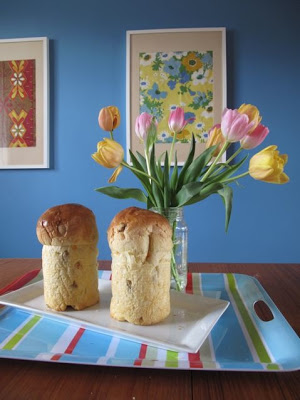
Traditionally served at Easter, and part of the required items in the Easter basket to be blessed at church, Babka is a sweet, eggy bread. Our family likes our studded with raisins or currants. A lot of descriptions  online call it something between a cake and a bread. Not so in my world. I always think of Babka as a sweet, rich bread, baked tall and best with creamy butter. Keep your cinnamon and chocolate and your Jerry Seinfeld, Babka is for spring, with a touch of citrus.
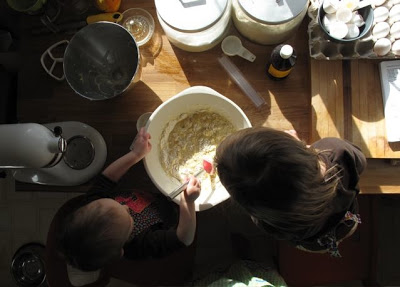
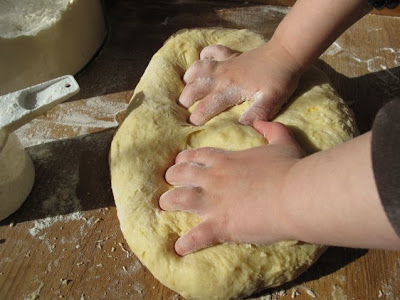
So the girls and I gathered our ingredients, put on our aprons, and set about to make a big giant mess. The good thing about making Babka is that it needs a lot of eggs, perfect for little hands. And what gorgeous little hands. I adore watching my girls' attack dough in their attempts to knead it. The Monster even has the push - turn - fold technique down now. And so long as we can keep Smilosaurus from snitching bits of raw dough we end up with a nice piece set to rise. And rise. And rise again. Be forewarned, from start to finish this is a full day affair.

This recipe starts out quite wet, what with all those eggs, milk, and a juiced orange. You will have to play with the flour, adding as much as necessary.  Just go slow, adding a few tablespoons at a time. Your dough is ready when it is smooth, aside from the raisins, no longer sticky, and relaxes a little, just a little, when you stop kneading.
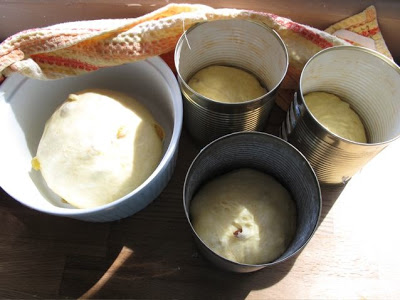
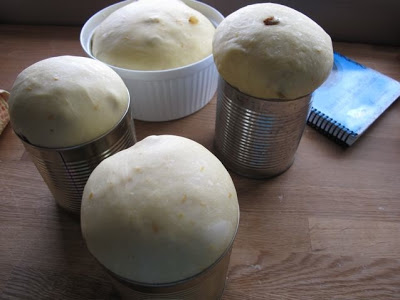

Babka is traditionally made into a tall, round loaf. You do this by baking it in cleaned out cleaned tin cans. You could bake it in a loaf pan, but that doesn't seem quite as fun, or traditional. If, like me, you don't have a lot of cans in your house you can ask a neighbour. Failing that, make plans to make sauce later and use the cans from some tinned tomatoes. Just make sure they are washed well. Then buttered quite well. If you are worried about the bread releasing from the can, line it with a strip of parchment paper, and more butter. 

And when you are all done, make sure you call your parents to share your success. Then butter some slices for the next generation and enjoy with tea. Church blessings optional.
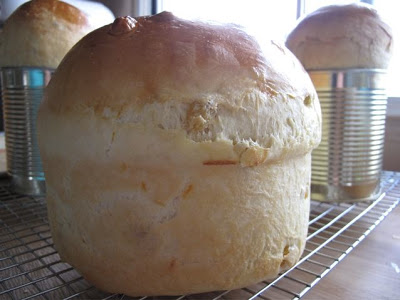
Ukrainian Babka
Makes 5 large tin size loaves, more or less depending on the size of container

1 tsp  plus 1/4 cup sugar
1/4 cup warm water
1 package Active Dry Yeast
3 whole eggs
5 egg yolks
1/2 cup melted butter
1 cup warm milk
1 tsp salt
1 orange, zested and juiced
1 tsp vanilla
4-5 cups flour
1 cup golden raisins or currants
1 egg, beaten

1. Dissolve 1 tsp sugar in warm water.  Add yeast and let stand 10 minutes.
2. Soak raisins in warm water. Drain well.
3. Beat eggs and yolks until light - 4 minutes with stand mixer, about 8 minutes by hand. Stir in remaining sugar and beat 30 seconds more. Add melted butter, milk, salt, orange juice and zest, and vanilla. Mix well.
4. Mix the wet ingredients to the 4 cups flour in a large bowl. Mix together well.  Add flour, if necessary, 1/4 cup at a time until you get a wet dough. 
5. Turn out onto a floured countertop and knead.  Add flour in small bits until the dough is smooth.  Knead for 4 minutes or so. In two batches knead the drained raisins into the dough. Knead until the dough is smooth and elastic. Place in a clean, buttered bowl, rub a bit more butter on the dough and set in a warm, draft-free spot to rise.
6. Let rise until double in size.  Punch down and let rise again.
7. Butter cleaned tins, dish, or pans. If preferred, line with a strip of parchment paper, then butter that as well. Form dough into balls that will fill container of choice to 1/3. Place in container and let rise again.
8. Preheat oven to 350 degrees F. Brush the tops of the babka with beaten egg.  Bake for 20-30 minutes, depending on the size of your container. It should be nicely browned and have a hollow sound when you tap it.
Bitaemo

A line of dancers - men dressed in red pants and white, puffy sleeved shirts and women in embroidered velvet vests with flowers and ribbons in their hair - stand in a semi-circle.  With one hand on theirs hips the other stretches to the side, beckoning your eye to a gap in the line. From that gap emerge two women holding nothing but salt and an elaborately braided bread in their hands.  In contrast to the energy of the dance that proceeded them these women exude calm and warmth. They present the salt and the bread to the audience in a gesture of welcome and the performance continues.

If you've never been to a Ukrainian dance performance this must seem odd. For us Ukrainians though, the welcome gesture of bread and salt is ingrained.  By nature Ukrainians are generous and love to introduce a party. Performers have merely taken the tradition that is well known in any farm town or village and adapted it for their audiences.

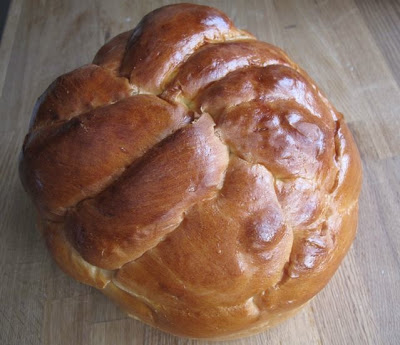
The bread in question is called Kolach.  Traditionally it consists of three wreathes of dough, braided intricately and stacked.  Centered in the middle of the wreathes would be a candle and the bread would be offered with salt for the home. Kolach is also one of the twelve traditional dishes of Ukrainian Christmas Eve.

I must be in a Ukrainian kind of mood this week with borscht and now this. But when our new neighbours moved in on Friday my first thoughts went to baking bread.  It should be noted that The Monster thought we should bring them cookies and Hubby settled on wine. Rather telling, don't you think? So I baked bread yesterday and we delivered a warm loaf, along with the cookies the girls and I made.

The recipe is one I pulled out of the family's go-to Ukrainian cookbook - The Alvena Homecoming Cookbook. In case you aren't from Saskatchewan, Alvena is a dot on the side of the road that is literally made up of three streets and a hundred farms.  And it happens to be my mom's hometown. The cookbook is 30 years old, published with a collection of recipes for the 75th anniversary of the Province. It includes such clear directions as "Knead well and let rise," as the first instruction and "Bake the same temperature as you do your own bread." I think I need to try the recipe again before I share a modern version.

In the meantime, I'm toasting our new neighbours - a couple under the age of 40 is still a novelty on our street - with my own Kolach.

Death By Food - Not Quite


The first time I invited Hubby over for Christmas Eve dinner he fully expected to die from food poisoning of the Ukrainian variety. That is, too much starchy, heavy food that includes grains that were either sickly sweet or mushy. And don't get me started on the pickled fish or sauerkraut and peas.  Death by Food, that's what Hubby called it.

Then he ate the meal, all 12 courses.  Ate would be an understatement.  Devoured is more like it. And he lived to tell the tale. Rather, he lived to tell me that I was crazy and that Christmas Eve dinner was a fantastically delicious meal.

Christmas Eve dinner always starts with Borscht - that classic red beet soup. The next few dishes are, well, something I can't stand (Kutia and Kasha), but the borscht always made me happy.  Except when we ate my Baba's soup and she put peas in it. In honour of Ukrainian Christmas on the 6th I wanted to share this recipe.

This recipe does not include peas.  Thank goodness for that.  Borscht is essentially a beet based vegetable soup.  You can add in other veggies, but I stick to adding beets and a few carrots to onions, celery, and garlic. A browse through any Ukrainian church cookbook will turn up a variety of recipes claiming to be Russian style or Dukhobor style.  I can't speak to them, but potatoes do not belong in borscht as far as my family is concerned. My Baba also often made hers with a ham bone, but to this is easily kept vegetarian by keeping the bone out.

Then there is the issue of exactly how to prepare your beets.  Pre-cooked versus raw in the soup? Chopped, grated, shredded, or sliced? I've settled on roasting, then peeling my beets. And I am firmly in the camp of slicing my beets into matchsticks. It provides a bit of toothiness to the soup, but not as much as you would get if you diced the beets. Yes, it takes longer, but it is a perfect Sunday morning activity with a three year old and a butter knife by your side.


Borscht (Just like my Baba's, minus the peas)
(8-10 cups)

3 pounds beets (6-8 medium)
1 medium onion
2 celery ribs
1 tbsp vegetable oil
4 medium carrots
8 cloves garlic, minced.
19 ounce can diced tomatoes
6 cups water/stock
ham bone (optional)
leaves from one bunch celery
1 tbsp chopped fresh dill

1. Heat oven to 350 degrees F.  Trim ends from beets, toss with a little bit of vegetable oil, salt, and pepper.  Roast in oven for 1 and 1/2 hours. Let cool completely.
2. Peel the beets. Julienne into 1/8 inch sticks, about 1-1.5 inches long. Do the same to the carrots. Set aside.
3. Finely dice the onion and celery ribs.  Saute with vegetable oil until soft.  Add in garlic and saute an additional 30 seconds. Stir in beets, carrots, tomatoes and their juice, and 6 cups water.  If using the ham bone add it now. Let simmer over low heat for about 2 hours, covered.
4. Turn off the heat, stir in the celery leaves and dill. Season well with salt and pepper. You can serve it immediately, but borscht benefits from sitting a day or two.
5.  To serve, garnish with a dollop of sour cream or creme fraiche.  Alternatively, drizzle with some heavy cream.

Pyrohy Addendum

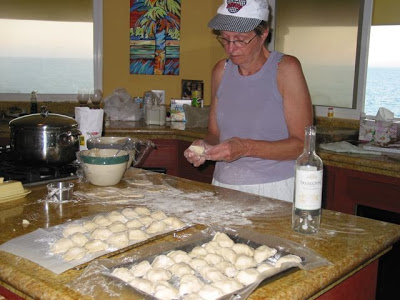
Lest I gave the impression that pyrohy are only for the days when your belly needs something solid to weigh you down, I thought I should share this photo.  This is my mom making pyrohy in Mexico, on Christmas Eve last year.  My pregnant sister insisted that it wasn't Christmas Eve without pyrohy so my mom, despite her desire to read on the beach, indulged her and made a batch.  Notice the empty wine bottle for rolling the dough!